
Introduction
Okay I'm going to dispel the myth that the Su-57 isn't stealth or 5th gen. There are several parts.
Intro
F-117 Incident
Stealth Technology
Top 24 Myths about Felon
RCS Numbers
F22 & F35 Vs Su-57
Weaknesses of Stealth Aircraft
Conclusion
This is based on over 30 hours of research, as well as several different scattering simulations. Sources are tied to each part instead of listed at end.
F-117 Incident
The minimum RCS the SNR-125M fire control radar can lock on relative to the RCS minimum of F-117, which was 0.2m² minimum required for lock on at any distance and RCS minimum of 0.005m² means its average was likely several decimal points higher. Of Course we take into account this was old stealth technology and the fact it had cueing from P-18.
It was detected because the RCS whilst having a minimum of ~0.005m², based on the fact it's an older design and current radar simulations its overall median in X band was likely ~0.008-0.01m² with a frontal median in X band of ~0.008m² this means its frontal RCS in VHF will be at ~0.8-1m². Which explains how the SNR-125 SAM FC radar of the system was able to lock on in the first place.
The F-117 was detected by the P-18 VHF early warning radar at around 25 km, they tried and Failed to lock the F-117 with the SNR-125M then again with radar assistance from P-18 twice, then at around 13 km using the SNR-125M fire control radar with cueing from the P-18 they got a hard lock and successfully shot down the aircraft, According to Zoltan Dani, the commander of the S-125 battery.
There is many myths on why it got destroyed around it off course, three biggest being
“NATO flew the same route”
● This of course doesn't account for the fact that others were targeted and hit.
“bomb bay doors were open”
● This cope was invented by the pilot and of course there is absolutely no evidence for this and it makes no sense. Now bay doors obviously open when firing but they are trying to argue that they bay doors opening caused an RCS spike and thats the reason it was detected was because they were open, again no evidence beyond what NATO says and especially when it doesn't even make sense since originally the S-125 crew were having trouble getting a lock once it was detected by the P-18 and in fact it took THREE different attempts (S-125 and P-18 were nearly 40 years old at that point) if the bay doors were open its RCS would be huge and easily detectable and lockable the first time.
“Serbs had spies”
● The final and most laughable claim was that the Serbs had spies and knew exactly where they had been flown but still doesn't account for the above issues and the fact that another one got hit and several were targeted. Ignoring that there is absolutely no credible evidence for this.
So what did happen ? Simple, it got detected. Simple as that, “its RCS minimum is 0.005m² and SNR-125 needs minimum 0.2m² for lock, so how could it ?”
See this is how there is a massive misunderstanding of how stealth technology works, we'll go over that in a bit. Many people say “we'll if it wasn't luck how come only 2 were hit” truth be told, it was luck, Serbia's radar systems were very old, they had skilled operators but most of their radars were older soviet P series that were early monopulse or doppler with basic digital upgrades allowing rudimentary radar data fusion and they had no OTH radars, as far as I know they had some C2 integration but it wasn't great, although better than Iraq who had no such integration. And as far I know they had little IR tracking abilities or the stuff they did have was either older tail chasing stuff with some all aspect abilities.
"So how come no iraqi S-125 shot down F-117s?"
3 issues.
1. Iraqs air defence was obsolete. They had no ECM protection for radars.
2. The models they used were older vanilla P-12 and P-14 type VHF series with very few P-18s, Serbia made extensive use of P-18s and their models used by Serbia were upgraded to base soviet level with analogue to digital signal processing and improved batteries to allow basic radar data fusion.
3. Iraqs IADS was crippled by ECM alone, their SAMs were blinded, serbian models had ECCM built into them with upgrades.
The issue was people think it was lucky they were seen when in reality it was lucky they got hit because of how dated the serbian equipment was. For context they got detected and hit by early 2nd Generation SAMs with 3rd Generation 2D radars, imagine what it would have been like with 3rd Generation SAMs (S-300 or Patriot) that utilised 4th Generation PESA search radars which was the modern standard by the 1980s.
Stealth Technology and mass confusion
Regarding stealth, there's two most common misconceptions.
“Aircraft is invisible to Radar"
This one is pretty common, people think stealth Aircraft are completely invisible to radar but in reality it's just reduced detection, modern radars that reduce clutter especially can still show a radar blip on the oscilloscope but the hard part is getting a radar lock. The fact that F-35s have been detected before proves this.
“Stealth Aircraft can't be locked”
This one is another common one, whilst it's true that getting a radar lock can be difficult, testing and F-117 Incident proves it can be done not to mention the fact that it can easily be locked by infrared homing missiles and modern phased array radars can easily lock stealth aircraft at close ranges, not even mentioning modern aircraft like Su-35, F/A-18E, Rafale, J-16, Typhoon, Gripen etc. use sensor fusion so can fuse radar, electro optical and infrared targeting data into one.
A big point to make about stealth aircraft is that you can know the aircraft are there, even an F-22, a modern X band system on a fighter would be able detect it anywhere from 30 to even 60 km away and 200 to 300 km away for a large ground radar, depending on power, type, T/R count and band. The issue comes from getting a lock which would be a fraction of those distances, a strong IR tracker could lock it or a modern FLIR system but these only have ranges of 40-150 km. The best response would be to deploy Interceptors with powerful radars/IRST and long range missiles such as MiG-31BMs armed with R-37Ms which utilise modern OSNOD data link with high speed data exchange between A-50Us, A-100s or Nebo radars which are high powered VHF and L band systems that link targeting data to the aircraft.
This is also just single bands, an X band fire control radar supported by a VHF radar would have a far higher chance of lock, as proven by the F-117 hits.
These are also just single aircraft, stealth fighters work best in single units or squads,if you launched a bunch of Raptors at once it would be easily spotted.
Radar Cross Section Confused
What is RCS? As discussed this stands for radar cross section, basically what how big aircraft shows on radar is. There's 3 sets of these numbers.
RCS minimum
The RCS minimum is just the lowest possible RCS that the aircraft is capable of in the most ideal conditions, so it's going to be from a single band of Radar (most always X band as these are most common for fire control radars) from a single angle and aircraft position under perfect ideal weather conditions, it is usually denoted as 50% lower than the lowest median frontal. This number is usually denoted as Xm²
RCS Median
You then have what's known as the frontal median in a band. So in each band, X band, L band, VHF etc, this is the middle RCS value in all cases within defined frontal horizontal arc. Meaning 50% of RCS spike inside the arcs will be higher than the median value, and the others 50% of RCS spike inside the arcs will be smaller than the median value. So in each simulation there are various numbers based on various types. This number is usually denoted as Xm²
RCS Average
This is the aircrafts overall mean RCS in X band in all major angles in 6 axis. So it's the lowest high frontal median in X to the highest median in 6 axis in Y. This number is usually donated as X-Ym²
I use public Radar scattering simulations for numbers.
You've also got to remember these are idealised numbers, even with F-35 or F-22 radar spikes can be very unpredictable especially in different weather conditions, and these are just airframe approximations, you've also got to remember different aircraft are more stealthy in certain frequencies. The F-35 is overall more stealthy than Su-57 but as an example the Su-57 has slightly better frontal stealth in VHF than the F-35 and the J-20 has better back cone stealth in X band than F-35. Although you need to remember, these are just airframe approximations and don't fully account for radar absorbing materials as the materials are classified.
Sources
So now i will debunk the myths regarding the Su57.
Top 24 myths about the Su-57 Felon.
In this part i will go over 24 common myths or misconceptions about the Su-57.
I genuinely think there is a psyop against the Felon because so many people repeat false claims, below I will answer the 24 most common myths and questions about the Felon.
1. "It's same RCS as hornet"
By FAR the biggest myth here, its hilarious because of how wrong it is, the F/A-18 Advanced Super Hornet has an RCS minimum of 0.1m², it was an experimental variant by Boeing with heavy RAM coatings, internal weapon systems, enhanced low visibility airframes and stealthy exhausts, the normal F/A-18E is said to have a bare RCS minimum of around 0.5m² so it's median is 1m2 bare overall RCS average in X band is probably around 2-4m² nowhere near the felons median or average.
You also need to remember the Size difference, the Su-57 is around double the size of the super hornet and that these numbers are for the front facing, super hornets have no stealth features for the side, top or bottom or back facing, true of all low visibility airframes.
2. "It's RCS is bad it's 0.1-1m² whilst F-35 is 0.001m²"
This shows a fundamental misunderstanding of how stealth works.
Directly from the patent
“The technical result, which the invention is aimed at achieving, consists in reducing the value of the aircraft radar visibility to an average value of about 0.1-1 m2”
This is just a generalised number, from the original 2004 PAK-FA design in the patent.
Average could mean numerous things.
Overall average in all bands
Overall average in X band
Overall average in VHF
Average in front in X band
Average in side in VHF
Trying to imply that its RCS minimum is 0.1m2 or 1m2 or 0.5m2 from this shows you don't understand stealth or how radar returns work and don't know how RCS data is collected and discerned.
It very likely means the overall average in X band, for example based on scattering simulations an F-35 has an RCS single average in X band of 0.06m² whist in reality it's RCS minimum is around 0.001m² with a median in the frontal horizontal axis of around 0.005m².
Average or mean RCS is always higher because its the average number radar return.
“So What is the number ?”
Sukhoi said that they intend the Su-57 to be 1/40th the frontal RCS of the Su-35S with an average radar return between 0.1-1m². The Su-35S has a median RCS around 1-3m² with a minimum around 0.5-2m² or in other words a frontal reduction between ~15-20 dB.
Su-35S RCS
Su57 RCS
This would give a median RCS of 0.0125m² to 0.05m² depending on what Su-35S front is.
I will use the highest RCS number to be fair, this means its median RCS is 0.05m², given that the median is always 50% higher and lower again we will use highest this would give an RCS minimum of 0.01m², this also correlates with the average given the mean rcs is the highest median frontal wise to highest median in 6 axis.
This gives the Su-57 an RCS in X band of
RCS Minimum: 0.01m²
RCS Median: 0.05m²
RCS Average: 0.1-1m²
3. "India thought it was rubbish"
Now. We need to get this out the way.
"India left the program because they thought it couldn't beat the F-22 and F-35"
That was the claim of senior indian military analysts. No. They left because they didn't pay for shit. Not only where they making ridiculous demands like stealth comparable to the F-22 but they also wanted the 360° radar suite and advanced agility (PAK-FA program was $10b vs ATF $70b) there had to be a compromise and only the last two were chosen, India wanted ALL 3 but weren't willing to pay for it.
Now I'm going to go on a tangent here. But India are the most delusional military on earth. Now I know that sounds harsh but its based on two facts.
A. The fact they could have purchased a whole fleet of Su-57s or upgraded all 260 of their Su-30MKI into SM2 standard (with AESA and hybrid PESA or just AESA, sensor fusion and new FCS and weapons) instead they bought 36 Rafales that they barely fly, all because they thought it was "prestige" and didn't want to be reliant on Russia. Only to lose 1-3 to J-10s even worse, they have decided to waste billions more buying Rafale.
B. When offered the Su-57E in 2025, the delusional Indian media and military GENUINELY and unironically said
"We want to use our avionics and radar as the felons is outdated"
These absolute ungrateful clowns who took 40 years from designing a 4+ Gen to actually building one whilst Russia did it in a few years, have no fighters in service with AESA whilst Russia has 5 and have no indigenous engines whilst Russia is a global leader and India who's only GaN radar is piece of plastic mock up whilst Russia has several in service.
Absolutely delusional.
This is a huge issue for India. Narcissism and insecurity. They are INCREDIBLY insecure about the fact that much of their military was built by Russia.
For example.
Instead of replacing their Tejas radars with Zhuk-A they thought we will build our own Uttam.
Thar failed and Tejas uses normal pulse doppler.
Derp.
Instead of buying Zhuk-AMs for their Su-30MKIs, AESA radars that are ready for export and mass production they decide on Virupaaksha, a fake mock up that hasn't even reached testing stage.
Derp.
Instead of upgrading their MiG-29Ks with a Zhuk-A AESA radar, OLS-13SM-1 EOTS and SOAR IR MAW and SOLO LWRs they buy Rafale-M for 10-15x the cost despite being no better.
Derp.
Instead of buying R-77MEs with an AESA Seeker they will wait for Astra Mk2 that yet again hasn't even proved that even exists.
Derp.
What's worse is these delusional clowns regularly mock Russian equipment because it fails. Because their air force can't maintain a simple 3rd Generation Fighter never mind 4th Generation. They consistently crash Su-30MKI, MiG-29Ks and Mirage 2000Is all the time which are mostly mechanical failures and their radars on their MiG-29s have repeated failures both due to dog shit maintenance, if you're wondering no, no other countries flying these aircraft or using Zhuk-MEs have experienced such problems. It is completely unique to India.
So expecting to have similar stealth capabilities as the F-117 or F-35 and a better airframe than an F-22 when you have spent a fraction of the money or time dedicated to R&D is pretty silly and not realistic at all. Although if I'm honest I just genuinely think India didn't want to spend the money so made an excuse because in the end that level of stealth would require at least $100 billion. Something that Russia was not willing to spend on, as again F-35 domestic at start costed 3x what the initial Su-57 cost and the lifetime program cost of the F-22 in research and development alone was close to $70 billion dollars and then there's building the first 100 at $200m each which was over $20 billion, then the JSF which is estimated to have cost over $300 billion in total R&D and nearly $10 billion building the first 100 at $100m each.
4. "Russia just doesn't have the technology or capabilities to build stealth aircraft"
This is nonsense, compare the above costs to the PAK-FA program, where the cost was around $10 billion at start with additional $20 billion in overruns with the first 100 T-50s at $50m each set to cost around $5 billion and with that Russia managed to build a stealth fighter but remember the F-22 was built with a primary $70 billion R&D budget for the ATF program and built upon an over $100 billion Stealth technology foundation with F-117 and B-2.
Whilst the only stealth foundation Russia had was the Soviet MFI program with its MiG-1.44 5th Generation prototype that probably cost less than a billion. So the fact people say Russia technology is bad, when Russia has spent at most $10-30 billion on research and development over a decade and made an aircraft that is only 10x less stealthy than the F-35 (but has many advantages in other areas such as radar, airframe and missiles) is absolutely ridiculous when the US made the F-117 it was nearly double the Felons costs and by time F-22 came around the USA had already spent over $100 billion on research and development over the course of two decades with the F-117 and B-2 programs not including the $70 billion ATF program itself.
The fact it's nothing to do with Technology capabilities, if Russia was willing to spend that much on it's aircraft R&D then it would, instead Missile technology is where most of Russia's R&D budget goes, which is why Russia already has multiple hypersonic missiles in production and the United States recent cruise missile prototype failed in June 2023. It's why Russia has anti-satellite weapons that can accelerate to supersonic speeds immediately, it's why Russia has 4+ Generation Tanks in active service, it's why Russia has 4th Generation Manpads in service, it's why Russia outnumbers the US in modern digital ground based AESA radars and counter batteries nearly 5-1 and its why they outnumber the US in modern EW systems nearly 7-1, it's why their 3rd best SAM beats US premier SAM in detection range, tracking abilities, missile Range, engagement time and deployment time and it's why when US had not long made a SPAG with digital FCS, with solid state electronics, an automatic laying system, a digital ballistic artillery calculator, an INS, a mission control screen and a digital radio system Russia like Germany were building stuff with fully digital FCS, advanced computers, global navigation systems, SATCOMS and better deployment times and lastly it's why Russia has had modern radar missiles in use since 2018 with AESA seekers, advanced ECCM and ranges of 200 to 400 km whilst US only just tested the AIM-260 in 2021 and won't have a version that can be used inside its stealth fighters (like the R-77M and R-97 can) until 2026-2027.
We also have the S-70 drone and Su-75 with an RCS similar to F35, then we have multiple stealth missiles like Kh-59MK2, Kh-69, Kh-101 and Kh-SD.
5. "The design of the Su-57 is inherently unstealthy"
False.
The Su-57 uses a full stealth design.
● Its nose is angled not round.
● It uses internal weapons bays.
● Its engine intakes utilise partially curved. ducts with radar blockers ahead of fan blades.
● It uses full X band absorbing coatings on all areas of airframe and engine nozzles with an initial thick sheet then final coatings on top.
● It uses a special glass type on cockpit which is effective at absorbing X band frequency.
● Its frame uses faceted and blended shaping.
The only non stealth design are the engine nozzles which are not faceted
Directly from a very well sourced radar scattering simulation from respected aussie air power
"By US definitions, a mature production PAK-FA would qualify as a Low Observable or Very Low Observable design"
"This study has explored the specular Radar Cross Section of the Sukhoi T-50 prototype aircraft shaping design. Simulations using a Physical Optics simulation algorithm were performed for frequencies of 150 MHz, 600 MHz, 1.2 GHz, 3.0 GHz, 6.0 GHz, 8.0 GHz, 12.0 GHz, 16.0 GHz and 28 GHz without an absorbent coating, and for frequencies of 1.2 GHz, 3.0 GHz, 6.0 GHz, 8.0 GHz, 12.0 GHz, 16.0 GHz with an absorbent coating, covering all angular aspects of the airframe. Modelling has determined, that if the production T-50 retains the axisymmetric nozzles and smoothly area ruled sides, the aircraft would still deliver robust Very Low Observable performance in the nose aspect angular sector. Conversely, if the production T-50 introduces a rectangular faceted nozzle design, and refinements to fuselage side shaping, the design would present very good potential for robust Very Low Observable performance in the S-band and above for the nose and tail aspect angular sectors, with marginal performance in the beam aspect angular sector. This study has therefore established through Physical Optics simulation across nine radio-frequency bands, that no fundamental obstacles exist in the shaping design of the T-50 prototype, which might preclude its development into a genuine Very Low Observable design with constrained angular coverage.”
On T-50 Prototype.
"The low observable design shaping employed in the PAK-FA prototype shows an excellent grasp of the design rules employed by American designers in the development of the F-22A and YF-23 Advanced Tactical Fighter”
"The most prominent feature of the T-50 is its
shaping, which is without dispute intended
to provide a genuine stealth capability in the
forward hemisphere, and possibly also in the aft hemisphere"
6. "Its too big"
Size is irrelevant look at the size of the B-21 with RCS minimum of around 0.001m² or the B-2 with an RCS minimum of 0.1m²
7. "It's not true 5th Gen rather 4.5 low visibility aircraft "
False it's 5th Gen by all standards. There are 4 main criteria for 5th Gen, which are full stealth, powerful modern phased array radar, powerful computer systems with sensor fusion between avionics.
A true low observability fighter by definition is one that uses
Stealth airframe (blended fuselage, angular shaping, RAM coatings, stealth exhausts, stealth nozzles and internal weapon bays)
Has average radar return below 1m² as this is below what most X band fire control radars can lock at a reasonable distance.
The RCS sources have already been explained.
For people who say it's a low visibility aircraft like Advanced Super Hornet. No. Categories below.
Categories for Conventional Aircraft RCS
0 = number
> = and greater
< = and lesser
Very Large Aircraft = 40m²>
Tu-95, M-4, B-47 and B-52
Large Aircraft = 20m²>
F-15, F-14, Tu-28 and Tu-22M
Normal Aircraft = 10m²>
MiG-25, Su-27, F-106 and F-4
Small Aircraft = <5m²
MiG-21, MiG-29, F/A-18 and F-16
Categories for Reduced Visibility Aircraft RCS
Low Visibility Aircraft = <1m²
F/A-18E, B-2, Su-35S and MiG 1.44
Low Observability Aircraft = <0.1m²
F-117, F-35, Su-75 and Su-57
Very Low Observability Aircraft = <0.001m²
F-22
List of Russian, Chinese and US reduced detection Aircraft
Russia
Tu-160 = Estimated RCS of 10m²
Su-34 = Estimated RCS of 5m²
Su-30 = Estimated RCS of 4m²
Tu-160M2 = Estimated RCS of 2m²
Su-35S = Estimated RCS of 1m²
Yak-130 = Estimated RCS of 1m²
MiG-35 = Estimated RCS of 1m²
MiG-29K = Estimated RCS of 1m²
MiG 1.44 = Estimated RCS of 0.3m²
Su-57 = Estimated RCS of 0.01m²
Su-75 = Estimated RCS of 0.005m²
S-70 = Estimated RCS of 0.005m²
USA
F-15EX = Estimated RCS of 5m²
B-1B = Estimated RCS of 5m²
SR-71 Estimated RCS of 3m²
F-16V = Estimated RCS of 1m²
F-15SE = Estimated RCS of 1m²
F/A-18E = Estimated RCS of 0.5m²
F/A-18E ASH = Estimated RCS of 0.1m²
B-2 = Estimated RCS of 0.1m²
RQ-170 Estimated RCS of 0.005m²
RAH-66 = Estimated RCS of 0.005m²
MQ-25 Estimated RCS of 0.005m²
XQ-58 Estimated RCS of 0.005m²
XQ-67A Estimated RCS of 0.005m²
X-32 = Estimated RCS of 0.005m²
F-117 = Estimated RCS of 0.005m²
F-35 = Estimated RCS of 0.001m²
B-21 = Estimated RCS of 0.001m²
RQ-180 Estimated RCS of 0.001m²
F-22 = Estimated RCS of 0.0001m²
F-47 = Estimated RCS of 0.0001m²
YF-23 = Estimated RCS of 0.0001m²
X-47B = Estimated RCS of 0.0001m²
China
J-16 = Estimated RCS of 5m²
JL-15 = Estimated RCS of 1m²
J-15T = Estimated RCS of 1m²
J-10A = Estimated RCS of 1m²
J-10C = Estimated RCS of 0.1m²
J-20 = Estimated RCS of 0.005m²
H-20 = Estimated RCS of 0.005m²
GJ-X = Estimated RCS of 0.005m²
J-35 = Estimated RCS of 0.001m²
GJ-11 = Estimated RCS of 0.001m²
Type A = Estimated RCS of 0.0001m²
J-50 = Estimated RCS of 0.0001m²
J-36 = Estimated RCS of 0.0001m²
FH-7A = Estimated RCS of 0.0001m²
Various
Tejas = Estimated RCS of 0.5m²
Rafale = Estimated RCS of 0.5m²
Typhoon = Estimated RCS of 0.1m²
KF-21 = Estimated RCS of 0.01m²
AMCA = Estimated RCS of 0.01m²
KAAN = Estimated RCS of 0.001m²
Shinshin = Estimated RCS of 0.001m
FCAS = Estimated RCS of 0.0001m²
5th Gen is also defined by powerful computer systems, Felon has a BagrOS-4000 4-5 million SLOC-OS with ICS-57 C4ISR software which is double more than F-22
It has a 12x integrated AESA radar system with over 3000 T/R modules which is more than F-35 and F-22 with a GaN AESA EW System and radar (radar Details below)
It has a SUO-57 full sensor fusion linked fire control (known in Russia as advanced full data fusion) with all digital systems thanks to its MIRES individual modality sensor fusion system which is also used on Su-75. The MIRES system fuses all data into a single sceen with full targeting fusion.
and other less capable sensor fusion versions known as KPrNO-35 are used on Su-30SM2, Su-34M, Su-35S and MiG-35. (Not individual modality) This fuses radar, INS, IRST, EOT, TDL, RHAWS, ESM, ECM, MAW, RFCM and IRCM on to a single screen with basic targeting fusion.
How sensor fusion works and how it can potentiate targeting
8. “Defence analysts say it's stealth bad”
Are these the same "analysts'' that say Russia has been getting hammered in Ukraine for 3 years or that Russia has run out of missiles and men or that Russian tanks are all bad ? In the end nobody knows what the Felons RCS minimum is, just like nobody knows what the F-22 or F-35 is. We're just using radar simulations and the manufacturers own statements to arrive at an educated guess. Anybody saying it's X or Y for definite has no idea what they're talking about.
Because it's russian thats why these "analysts" cry, same thing happened with the T-14 Armata in 2015, Ka-52 Alligator in 2000s, MiG-25 and MiG-23 in 70s, T-72 and T-80 in 90s etc. many of these so called military “analysts” are basically propagandists because the TRUTH is nobody knows what the real RCS is, heck nobody knows how powerful it's radar is, because they've never been tested by an independent 3rd party just like the Raptors or Lightnings systems haven't, we've tried to come to a conclusion using the best available evidence and computer tests.
9. “its RCS is 1m²”
No idea where this myth came from. It doesn't even make sense considering it's intended average on the original patent prototype was 0.1-1m and the RCS minimum is always MUCH lower than the average. It also makes no sense because Russia's Su-35S, MiG-29K and MiG-35 that have RCS minimums of 1m² or below so the idea that its premier stealth fighter has the same stealth as a flanker/fulcrum upgrade and worse stealth than the MiG 1.44 is absolutely ludicrous.
Original Su-27 and MiG-29
Modern versions with RAM applied to front and Engines with radar blockers in engine.
Other modern 4.5 Aircraft with low visibility airframes.
10. “its never seen combat which proves its bad”
Ignoring the fact that this doesn't prove anything, it has been used in Ukraine several times. It has not only been used in Ukraine but Syria as well and it scored a long range kill of a UAF Su-27 with its R-97 that Ukraine thought was an SAM system, likely because they couldn't see it on radar thanks to stealth and ECM.
11. “You can see its bolts and screws therefore it's stealth is bad”
The rivets and screws in question are on T-50 prototypes which are used for training or publicity. It is important to consider that the original PAK-FA prototype does not represent a production configuration of the aircraft, which is to employ a new engine design, and extensive LO treatments (such as radar absorbing material treatments, bolt and rivet coverings, leading edge trail treatments, radar blockers for exposed bearings installed, additional RAM on spike areas etc) which are not required on a prototype. A number of people and propaganda groups have attempted to draw conclusions about production PAK-FA LO performance based on the T-50 PAK-FA prototypes.
Serial produced airframes have all rivets and screws flush and covered in RAM with radar blockers in engine duct and RAM treatment on all trails and gaps. See the difference between the T-50 and Su-57S
T-50
Su-57S
Side by side comparisons of T-50 vs Su-57S
Frame coated with RAM on Su-57S
Bare frame on T-50
"Why does Russia let the T-50 look like this"
Because they are only used for promotion or training purposes, Let's not forget that older F-22 airframes used for similar reasons all have visible screws or panels or are just in poor condition.
You can literally see the difference in visible rivets when the RAM layers is applied to production aircraft.
RAM is made up of two layers. The first is the initial thick layer which is usually a composite sheet made of hexagonal coatings then the final RAM "paint" It's not actually paint but a thin layer that goes on top to seal all areas.
Source explaining below.
Pre post RAM coatings
Post RAM coatings
Same on F35
Pre RAM on top picture base layer being added on bottom
Can literally see the initial hexagonal film applied to the airframe that goes under the main RAM coatings.
12. “It doesn't have DSI ducts therefore it's not a true stealth airframe”
This is why people should just read the patent or information given from Russia. No it doesn't use full DSI ducts, instead it uses partially curved S ducts with RAM applied to the openings and a set of two radar blockers next to the fan blades similar to what the F-117 did. This was done because they wanted to fit 4x R-97s and large precision ground munitions inside the weapon bays and allow a for a higher agility airframe.
Again read the patents
This is a radar blocker.

Partially curved ducts
13. “It has gaps between its panels and bumps therefore isn't really stealth”
Yeah this is just nonsense and has no effect on stealth capabilities. Both F-35 and F-22 have bumps and gaps.
14. “Sukhoi themselves said it was 0.5m²”
Again I have honestly no clue where this came from same as the 1m2 claim, there's Again no evidence beyond hear say. Is laughable to think premier stealth fighter would have worse rcs than MiG 1.44 tech demonstrator and slightly better than a fulcrum upgrade.
15. “Leaked documents show it's RCS is higher than 0.1m²”
This is just nonsense, I've heard this repeatedly so many times it's laughable. There's two types. The first are people using the patent and saying “it's RCS is 0.5m² because it says 0.1-1m² on document” not understanding that
That's an average return aswell so the median and minimum is going to be much lower.
The other type is showing some half assed “official documents” claiming it's RCS was 0.4m² or sometimes 0.6m² both are nonsense because they are just fantasy with no evidence to back up validity.
16. “It's Engines don't merge with frame therefore it's not stealth”
This has nothing to do with an overall categorisation as a stealth aircraft. Proof? The YF-23.
17. “I've seen it carry Weapons on the outside, this proves it's stealth is rubbish”
Believe it or not this has genuinely been said to me and seen actual organisations say it. I guess by this logic the F-22 and F-35 aren't stealth either.
18. “It's glass cockpit doesn't have single touch screen like F-35 or J-20 therefore shows how lacking in technology it is”
Firstly Su57 does use a touch screen but it's irrelevant as it's literally an ergonomic preference. The Su57 uses modern ultra high definition LCD displays that utilise all primary and secondary controls unlike the F-22 which uses older Gen mini panels.
F-22
T-50 prototype cockpit
Pre production models and Early Su-57S models
Current Su-57S and Su-57M model.
System components
C2 computer
SPO-150-402 self protection suite
N036 Byelka multi positional GaAs/GaN Radar system and L-402 Himalayas EW System
ATOLL EOTS with FLIR and IRST.
ATOLL-N targeting pod
NSTsI-50 digital HMD
19. “It's radar is the weakest out of all stealth fighters”
Wrong. Its radar is actually one of the strongest. What people need to know is that the Su-57 has an integrated radar system called N036 Byelka with MIRES.
This area is quite controversial, there is little official sources for the N036 Byelka, only thing known is
Tracking data
Antenna arrays
So first. How many antennas ? According to
http://su57.mariwoj.pl/su57-index.html there is 8× L band and 4× X band. But they get a lot of stuff wrong, such as production numbers, sensor uses, naming etc.
We need to use our eyes.
We can see radiation warnings on nose, rear, nose side, levcons and wings.
We can also see the T-50-8 Prototype that has radars painted in teal (I believe this Prototype was made to test the radars)
So it seems they are right, there are 4× X band antennas and 8× L band.
We also have teal in the upper sections which hints at a height finding radar to support 3D searching for the wing radars. (Or could be communications)
How many T/R modules?
Completely unknown, sources vary wildly from 1,514, 1522, 1526 and 1552 for front facing system and 358 and 404 for side system.
So I counted
Two different radars.
2009 Prototypes (made in early 2000s)
2015 models
Counts below
1642 for the current known radar
1436 for original prototype for T-50.
401 for current known model
The N036L-1-01 L band arrays each have 12× T/R modules, the N036L-1-02 arrays are around half the size so 6× T/R modules is a good estimate.
You can clearly see the advancement in AESA technology.
Early 2nd Generation GaAs modules.
Later 3rd Generation modules

Timeline
It's possible that the current production model nose radar uses even more. Based on the size the theoretical largest amount of T/R modules could be anywhere from 1700 to 2000 for GaAs and 2300 to 3000 for GaN.
We have the rear radar system, which is a GaN based rear AESA radar, that looks like a patch antenna array, that is part of the L-402 Himalayas EW system that also utilises the aircrafts other 3 X band radars for ECM. This can perform active jamming against enemy fighters.
No info exists so we need to estimate. In millimetres.
Need to account for parachute
700×300mm seems appropriate.
Closest analogy would be AN/APG-79 with 700mm antenna diameter
Total of 1368 T/R modules with 672 in the rectangular block, these are early 2nd Generation GaAs aswell. So will even it out with ~1000 since its larger and uses GaN.
The main radar system is the N036 Byelka which is an advanced X/L band all digital multi positional AESA radar system that utilise slotted planar arrays with 3,516 GaAs/GaN T/R modules in total. There are 8x total antennas, with 4× X band and 4× L band in total with the following, 1× N036-1-01 main X band nose radar with 1,642 GaAs T/R modules, 2× N036B-1-01 X band cheek radars with 802 GaAs T/R modules and 4× N036L-1-01 and 4× N036L-1-02 with 72 large antenna GaAs T/R modules, there is also the N036Kh rear facing X band antenna with 1000 GaN T/R modules.
All data and sensor information is fused into a single target on one sceen through ICS-50 system which integrates all data from the radars, the L-150-400 self defense suite and the ATOLL electro optical, infrared tracking/imaging and laser targeting system, along with the MIRES system that integrates communications and has far superior independent sensor integration with individual modality sensor fusion.
This gives the aircraft unprecedented situational awareness with ability to track targets at practically all angles and lock side a rear targets depending on range. The aircraft was built to kill deep penetration stealth fighters like the F-22 with high focus on agility, WVR and BVR.
This not only gives the Felon amazing situational awareness (as it allows a nigh full 360° protection against all types of missiles and all types of detection and tracking by aircraft) but an incredibly powerful radar and can make use of long wave L band radars which stealth aircraft are more vulnerable to.
Scan search limits by band
X Band For 1-3m²
L Band for 0.5-3m²
20: "The L band system is just for IFF and has no target search or tracking abilities"
Nope.
The L band system is the game changer, Only the front cone radar has ~1600 T/R modules but people forget that it's an integrated sensor fused system so you need to count the other radars.
L band which use long wave forms to have excellent range. L band system alone (based on AAPs estimate of a 12× T/R modules array bunped up to 48 T/R array)
~150 km tracking vs 0.1m²
~400 km detection vs 3m²
Fighters that utilise true stealth shaping and intensive RAM coatings will have much higher returns in L band vs conventional airframes. (Usually on order of 8 to 12 dB) an F-22 for example has a median average RCS of around 0.005m² whilst in L band it would be 0.05m².
As stated before, sensor fusion targeting potentiates tracking system by integrating all targeting data into a single framework, meaning on the HUD a target will be displayed using both X/L band combined with the tracking data from the IRST. Higher end sensor fusion systems like on F-35 and Su57 also integrate individual sensor modalities.
This means the L band signal can be used in combination with X band (or IRST) and achieve a weapons grade lock. (Something that would be impossible for L band alone)
With the L band radars alone they could track the F22 at 80 km and F35 at 150 km.
With X/L band sensor fused targeting, A Felon could track an F-22 at around 100 km> and and F-35 around 200 km>, in a realistic scenario where F-22s would attempt low level penetration, they would be spotted by Nebo-M radars and targeting data would be relayed by OSNOD to Su-57.
4 quad radiator antennas above
These are the large antenna L band arrays that are used for mainly for 2D radar searching and tracking for IFF and greatly improved situational awareness. Propagandists have tried to lie and claim that
A. It's only for ECM
B. It's a passive IFF system
Offcourse they provide no Russian sources that back this.
The ECM claim is straight fantasy. It is part of the L-402 ECM system but not only.
IFF is more complicated.
NPP Pulsar (makers of the AESA components) have said themselves that these systems are for 2 purposes or multifunction.
"IFF with international SSR and search radar functions”
The last word is key. A search radar and its functions are what's utilised by primary radars (searching and tracking)
Key word multi function.
And as aussie air power says.
"For a dedicated IFF/SSR role, the Tikhomirov NIIP L-band AESA would simply represent gross “overkill” in performance and angular coverage, which is not characteristic of Russian design philosophy, nearly always focussed on the full exploitation of the technological potential of each design component"
He's talking about if this was just a simple IFF interrogator/transponder (ie passive with no search or tracking) then why are they using AESA ? Why is it in the wings ? Why does it need so many T/R modules as its operating in L band with large antennas ? Why does it need to cover so much area ? Why does it need such a long range ? If this was a next gen IFF for all models (like SO-96) why isn't in used in Su-27SM3, Su-34, MiG-31BM or MiG-35, in fact why wasn't it added to Su-30SMs ? If its just a new IFF SSR ?
An analogy would be you live in 10 House Row Street and you want to go to the supermarket thats at the end, usually you just pop in the car or get a bus.
No this time you build a helicopter.
That's how extreme it is, to build such a system for whats basically just fighter to fighter IFF.
It doesn't even make sense, why would a single fighter need to scan a 180° area at 200 to 400 km range just for IFF ? Such scans are what ground radars and AEW&C are for, and their targeting is relayed by data link, since the 90s the TKS-2M could do this between up to 20 subscribers (so each main ground radar or AEW&C could connect to 20 fighters or ground units) modern fighters (2010s) now use the OSNOD which has same capability but with up to 1800 subscribers and unlimited with satellite link.
You see how utterly pointless a system this powerful made purely for IFF/SSR would be ?
As AAP says
"Embedding an IFF/SSR function in the design simply increases the design payoff, as a single design can perform two functions, interleaving IFF/SSR interrogation messages with target search pulse trains"
It's just killing two birds with 1 stone.
For comparison here is old school and current (When the L band array was made) added L band soviet and Russian interrogator SSRs. These designs are used even in Hybrid PESA models like BARS-130 Osa and N011M Bars-M.
N007 Zaslon in 1976
N007AM Zaslon-AM in 1998
N011 Bars in 1987
N010 Zhuk in 1986
N010M Zhuk-M in 1996
N031 Zhuk-MSF in 2009
BARS-130 in 2012
N011M Bars-M in 1996
On AN/APG-63, AN/APG-70 and AN/AWG-9 aswell.
What do they have in common ?
Small ✔️
Dipoles for interrogator ✔️
Fixed to main radar ✔️
Same antenna type ✔️ (MSA are MSA ESA are ESA)
Not a SINGLE category is met when comparing how literally ALL other L band SSRs are built and used vs how this system is. Red flag 1.
The Su-57 takes it to an even more extreme, it has 8× L band radars offering over 300° coverage, it is absolutely ludicrous to claim that this is just an interrogator/transponder. Red flag 2.
For anyone wondering if they are used on modern AESA. No.
N036 Byelka
FGA-29 Zhuk-A
FGA-35 Zhuk-A
RBE2-AA
AN/APG-81
AN/APG-77
Captor-E
AESA L band integrators are integrated into the main nose.
So let's recap.
We have
● Statements from manufacturer that this is search radar functions
● State brochures saying these radars are multifunction not just IFF/SSR
● Clear indication showing how unique it is
● No logical explanation for why a normal interrogator/transponder needs such a system
● Arguments from experts explaining functions
Thata Red flag 3.
But yes "iTs jUsT aN iFf sSr", let's ignore all the evidence and live in la la land.
Sources
It should be noted there seems to be two different arrays. One with a quad radiator antenna array with 12 T/R modules
And one with what seems to be an improved radiator array with 24 antenna radiators per wing rather than 4 used on above. The N036Sh Pokosnik or the Type 4283 radar that integrates the Type 4283MP/4280MD interrogator/transponder system.
It's unknown if either the above radiator array was simply a more advanced option with better 3rd Generation AESA components used in both or just developed for the flanker series as it can only be seen on them. It's possible this system also utilises 3D searching. I will keep the Su-57 using the old system to be as fair as possible.
The original design had 3 groups of 4 T/R modules controlling 4 quad radiators per wing. If we assume that the same practice has been utilised here then that means since there are 24 antenna radiators each with 3× T/R modules that means there are 72 T/R modules per wing with a total of 144. But we can't see any groups of T/R modules, so it's very likely that the T/R modules have been integrated at the antennas which would give a minimum of 24× T/R modules per wing. This would give similar performance to the N036L used on Su-57 as it has 4× N036L-1-01 antenna each with 12 T/R modules. The original Su57 also has 24 L band antennas so it's possible this system was made to be similar for flankers.
Under construction for Su-35S below.
Even if its just a 2D search radar it can still work.
How 2D search radars work as early warning.
Another thing people forget is that these are used in conjuction with the N035 nose or N036 nose/cheek radars.
N035/N036 and N036L have always been a radar package.
N035 Irbis/N036L
N036-1-01 Byelka/N036L Byelka
21. “Only 30 have been made therefore it's bad”
Firstly this proves nothing and is wrong, Wikipedia is not a source ESPECIALLY regarding anything Russia. Secondly only 76 were ordered with around 300 planned. 2018 marked a huge jump for Russia with T-14 finishing state trials and 2S35 and Su-57 being approved for production, in 2019 pre production models T-50S-1 and TS50S-2 flew with one crashing, it was approved for mass production in 2020 with an IOC reached in 2022 and full service in 2024, there were still export and domestic orders for Su-30SM2, Su-34M, Su-35S, Tu-160M2 and Yak-130 needing fulfilled and the war started in 2022 meaning production was focused on Su-35s and Su-34s.
In factories 6 total airframes can be seen so 1-6 is a good estimate per batch.
Production numbers as follows. With 2 to 12 made in 2021, 4 to 24 made in 2022, 3 to 18 made in 2023, 4 to 24 made in 2024, 2 to 12 made in 2025 and 1 to 6 made in 2026. This amounts to a low of 16 made to a high of 96 made, statements by UAC said that there would be 20 in service by end of 2023 and 50 in service by end of 2024. During construction we can see 4 Su-57 airframes being built at once and 4 have been seen delivered at once, this averages out to around 66 Su-57S that has likely been made so far. So nearly all the orders fulfilled already in around 2 years isn't bad. But again this proves nothing.
Russia has 76 ordered with a further 212 Su-57M on stand by, by 2030 Russias fleet is to be
300× Su-75S
212× Su-57M
76× Su-57S
200× Su-35S
220× Su-34M
110× Su-30SM2
100× MiG-35
40× MiG-29KR
Deliveries
2023
Production models
22. “Su-57s IRST makes it non stealth”
This is why people need to do research.
IRST exposed
IRST retracted
We can see that it retracts, the other side is coated in RAM.
It should be noted though that the non angled optic absolutely causes a spike in radar returns when in use.
23. "The AL-41 Engines are not stealth"
False. Now the claim is because they are not serrated this means they aren't stealth. For example here is the F135 turbofan for F-35.
And here is AL-41-F1.
Now yes, it doesn't have the serrated edge. But what they don't tell you is that this has nothing to do with radar RCS, serrated nozzles is for reducing thermal heat, nothing to do with RCS or radar. The AL-41 engines like most 5th Generation engines has supercruise, thrust vectoring and RAM coatings applied to nozzles. The F135 has no supercruise ability so it shouldn't be classed as a 5th Gen engine by this silly standard.
We have the AL-51 that like the AL-41-F1 has RAM coatings but also adds a serrated nozzles for improved infrared stealth. This will be used on the Su-75.
We have the AL-51F-1 that like AL-41-F1 has RAM coatings but also a facetted flat nozzle for highly reduced radar returns. This will be used on the Su-57M.
24. "Su-57 was spotted with a satellite radar this probed its stealth is bad"
So much wrong with this, first hete is the image.
So.
First. That image is laughable, could literally be any aircraft and the fact you have to draw an outline to even see it speaks volumes.
Second. This proves nothing as SAR can see any stealth aircraft especially from top down which has limited stealth and especially since this would have been a T-50 with no RAM.
Su-57 RCS Numbers
So What is the RCS then ? Well that's what this is about, these numbers are from using various simulations and sources. Numbers are taken mainly from the front facing. We use averages. We have checked, double checked and checked again and done far more digging than last time, these are probably the most accurate estimates you're going to get.
All numbers are for horizontal frontal facing.
Based on the scattering simulations the Su57 bare airframe has an RCS reduction of around 5 to 10 dB in X band whilst with RAM coatings applied this jumps to 15 to 25 dB in X band.
(These are for X band only, check my scattering simulation sources for full breakdown)
So we will do 3 sets of numbers. Lowest, most likely and highest using the numbers.
Lowest RCS
Post RAM
RCS Minimum: 0.005m²
RCS Median: 0.0075m²
RCS Average: 0.01-0.1m²
Pre RAM
RCS Minimum: 0.05m²
RCS Median: 0.1m²
RCS Average: 0.1-1m²
Medium RCS
Post RAM
RCS Minimum: 0.01m²
RCS Median: 0.05m²
RCS Average: 0.1-1m²
Pre RAM
RCS Minimum: 0.1m²
RCS Median: 0.5m²
RCS Average: 1-2m²
Highest RCS
Post RAM
RCS Minimum: 0.05m²
RCS Median: 0.075m²
RCS Average: 0.5-1.5m²
Pre RAM
RCS Minimum: 0.5m²
RCS Median: 1m²
RCS Average: 2-3m²
PAK-FA Numbers (patent and statements from sukhoi)
Highest Estimate
RCS Minimum: 0.01m²
RCS Median: 0.05m²
RCS Average: 0.1-1m²
Lowest Estimate
RCS Minimum: 0.005m²
RCS Median: 0.01m²
RCS Average: 0.1-1m²
Overall Numbers
Post RAM
RCS Minimum: 0.005-0.05m²
RCS Median: 0.0075-0.075m²
Pre RAM
RCS Minimum: 0.05-0.5m²
RCS Median: 0.1-1m²
So yes, not as stealthy as the F-35 or F-22 but certainly not comparable to any Hornet, Rafale or Typhoon and absolutely classed as a true low observability aircraft or “stealth”.
F-22 & F-35 Vs Su-57: Battle of Air Superiority
What's better Felon or raptor ? Let's cut the shit and get right to the stats.
F-22 vs Su-57
Manuvarabilities: Felon
Turn Rate: Felon
Speed and Endurance: Draw
Engines and Airframe: Draw
Stealth: Raptor
Fire Control: Felon
Targeting: Felon
Ordinance Capacity: Draw
Guns: Raptor
Countermeasures: Felon
Electronic Warfare: Felon
Radar Missiles: Felon
IR Missiles: Draw
Weapons Systems: Felon
Navigation: Felon
Flight Control: Draw
Communication & C2: Felon
Raptor: 7
Felon: 15
Easy win.
F-35 Vs Su-57
Turn Rate: Felon
Engines and Airframe: Felon
Manuvarabilities: Felon
Speed and Endurance: Felon
Stealth: Lightning
Fire Control: Draw
Targeting: Draw
Ordinance Capacity: Felon
Guns: Lightning
Countermeasures: Felon
Electronic Warfare: Draw
Weapons Systems: Felon
Radar Missiles: Felon
IR Missiles: Draw
Navigation: Draw
Flight Control: Draw
Communication & C2: Draw
Lightning II: 9
Felon: 15
Weaknesses of Stealth Aircraft
Stealth fighters are a wonder in engineering but they are not invisible.
Stealth Aircraft have four weaknesses.
Low frequency long wave radars.
Stealth Aircraft are particularly vulnerable to lower bands of radar like L band because most RAM used on stealth fighters is tailored to absorbing X band wavelength because it is most commonly used by fighter jets and many air defence radars. VHF radars also fall under this category. These radars work in similar fashion to low frequency ones. It was a P-18 VHF radar that located the F-117s. Russia has developed the Nebo-T, an all digital GaN AESA variant for protection against B-2, B-21, F-22, F-35 and X-47B that can be used by S-500 and S-400.
VHF radars especially are incredibly effective at detecting stealth aircraft due to their nature and because most RAM is suited towards X band. Taken from SPF by stealth flanker.
The following is an example that i did. This is a lifting body stealthy cruise missile. As seen it is capable of extremely low RCS in expected frontal section. it reached a median 0.002 sqm Without RAM treatment. it is a pure PEC body.
You can see the behavior of the Reflection in different frequency, notice that the strongest reflection comes from wing area from X to L . It may be very strong but The lobes are relatively small, it will be hard to pick the strongest part, as can be seen from the contourplot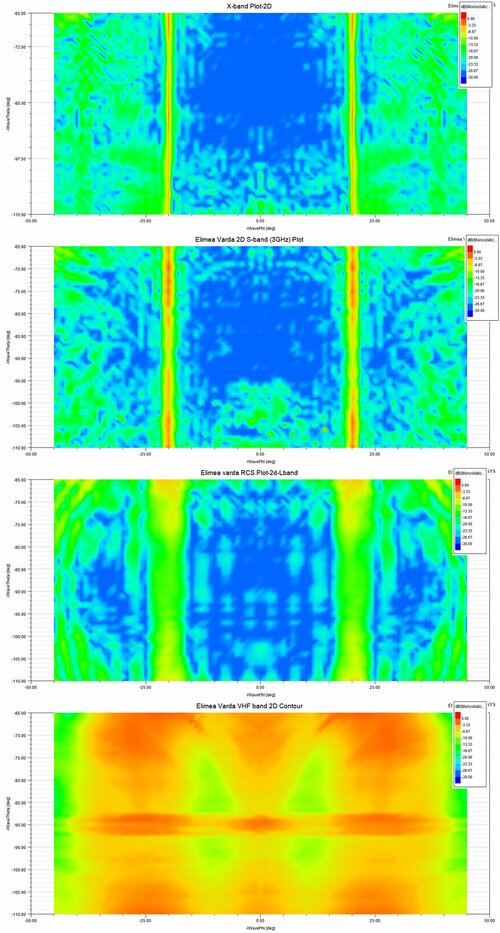
This is what you want to achieve. VHF however is another story where the missile shape lost its ability to control RCS and become blobs. Compare it to conventional cruise missile here at X-band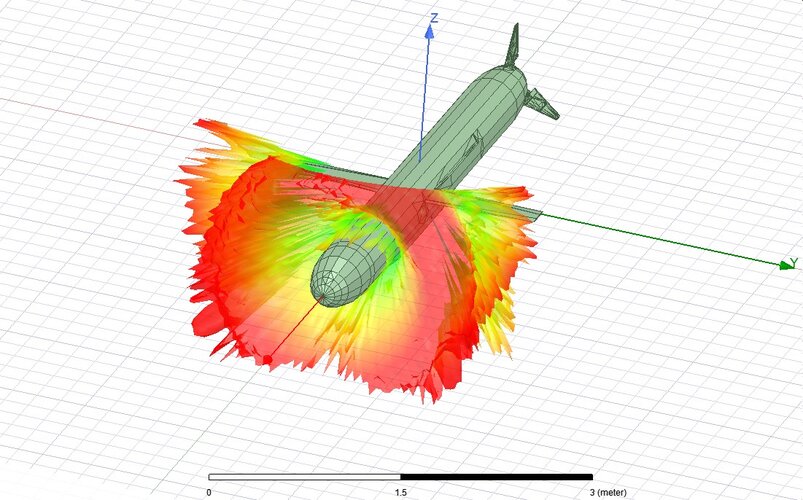 The contour plot
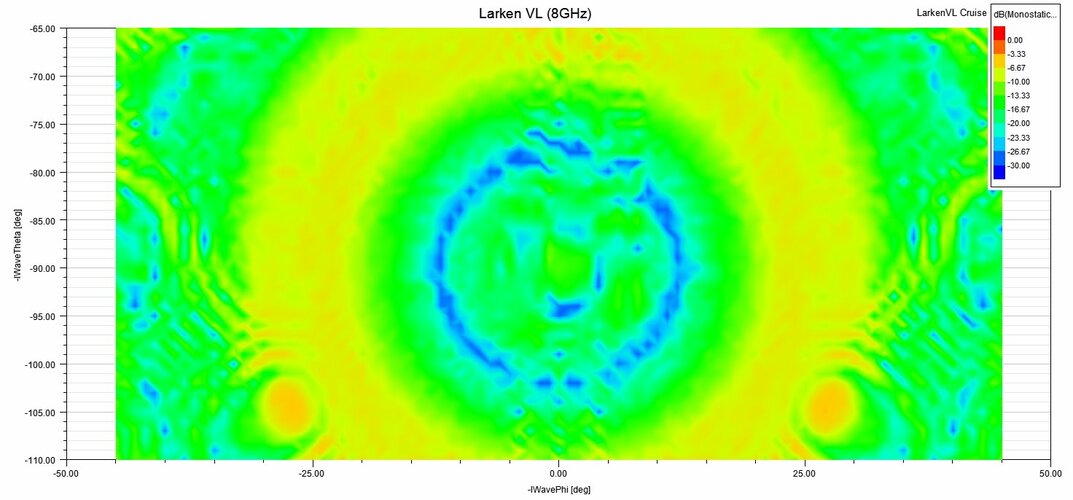 One can see the axisymmetric airframe gives "halo" reflection. still relatively small but when one see the numbers.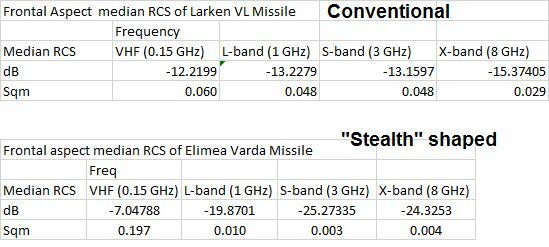
Notice the stealthy cruise missile give more dramatic reduction at higher frequency. While the conventional one the RCS is higher but not as fluctuating. You may also notice that the conventional have a bit of lower RCS in VHF band. This is the result of the MIE scattering. You may see lower RCS value in one frequency but not in the other and this conventional one happens to be in "favorable" frequency.
Example below.
This is why advanced AESA VHF radars like Nebo-M completely negate stealth at any reasonable altitude, they can track 0.1m² regularly at 100 to 500 km depending on altitude. An F-22 for example at 500 km at a 5 km altitude will have an RCS of around 0.1m² to 1m².
Only way stealth aircraft can counter this is to fly very low and terrain hug but then they completely reduce the range of missiles and can be spotted by look outs.
In X band
Su-57
RCS Minimum: 0.01m²
RCS Median: 0.05m²
RCS Average: 0.1-1m²
F-35
RCS Minimum: 0.001m²
RCS Median: 0.005m²
RCS Average: 0.01-0.1m²
F-22
RCS Minimum: 0.0001m²
RCS Median: 0.0005m²
RCS Average: 0.001-0.01m²
L band increases detectability by around 8 to 12 decibels whilst VHF does it by 20 to 25 decibels and HF 25 to 35 dB.
In L band
Su-57
RCS Minimum: 0.1m²
RCS Median: 0.5m²
RCS Average: 1-2m²
F-35
RCS Minimum: 0.01m²
RCS Median: 0.05m²
RCS Average: 0.1-1m²
F-22
RCS Minimum: 0.001m²
RCS Median: 0.005m²
RCS Average: 0.01-0.1m²
In VHF
Su-57
RCS Minimum: 1.5m²
RCS Median: 1m²
RCS Average: 2-3m²
F-35
RCS Minimum: 0.1m²
RCS Median: 0.5m²
RCS Average: 1-2m²
F-22
RCS Minimum: 0.01m²
RCS Median: 0.05m²
RCS Average: 0.1-1m²
Multi positional radars.
These are radars that are set up in different positions that face the aircraft on the X and Y triangular and linked by data fusion; these will make the aircraft much more visible to the radar and enable easier lock on.
For example an air defence regimental hub that oversees multiple early warning radars can use data from multiple radars to get better targeting data.
Over the Horizon radars.
These radars can detect stealth airframes by bouncing the signal on to the top of the aircraft where it is less protected.
Infrared detection.
Modern 3rd Generation IRST can track fighter sized aircraft up to 90 to 150 km and detect from 170 to 250 km, and Russian aircraft like Su-75, Su-57, Su-30SM2, Su-35S and MiG-35 all have these along with built in FLIR. Russia's Su-27, Su-30 and MiG-29 all have modern 2nd Generation IRST that can track aircraft up to 50 km and see aircraft in afterburner up to 100 km. It is effective for interception of aircraft as whilst even if a SAM fire control radar can't lock it, search radars can see it and launch aircraft to intercept and they can use IRST to track and help get a lock and Infrared or radar homing missiles to fir.
As Seen here with Su-35S OLS-35 tracking F-22 engine plume.
Or an F35 getting tracked and hit by IR Missile by iran.
The copium from both these incidents has been funny.
Sources
Conclusion
Stealth Aircraft are amazing machines no doubt but they are not invincible or invisible lol.
The fact is the Su-57 a solid fighter and the fact Russia built a 5th Gen stealth fighter in just over a decade which in comparison to the USA was with 6x less funding and 3x less time and didn't have the stealth technology foundation to build on, I think that's a testament to Russian engineering. People need to learn to put their personal bias aside and look at things objectively.


Comments
Post a Comment